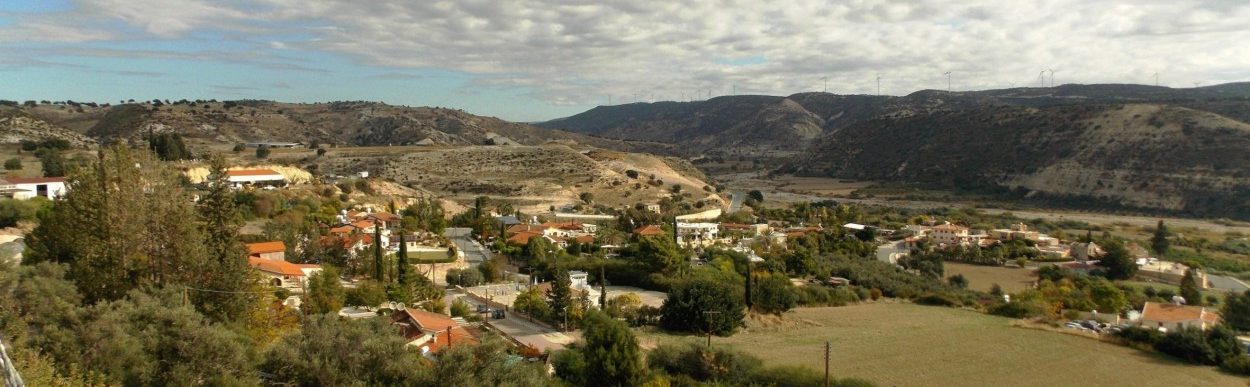
Agios Neophytos Monastery is located near the village of Tala, about 10 kilometres north of Paphos in a beautiful location surrounded by trees and rich vegetation.

Agios Neophytos Monastery
Agios Neophytos had originally carved himself a small chapel in 1159. The Saint had also carved another chapel east of Paphos near the village of Souskiou. This carved cave is known as Palaia Englistra and the icons are dated bacto the 15th or beginning of 16th century.

The Agiou Neophtyou Monastery was possibly built during the beginning of the 16th century and has three rooms with an arched room and a basilica with a dome. The original church had survived however many of its icons were destroyed during the period 1585-1611.  Today, only a few monks stay in the monastery which has a museum featuring many religious items like manuscripts, holy utensils, old books, priestly garments, jewelery and a collection of Cypriot pottery and maps on display. Every year in January the monastery holds a two day religious fair where you can find Cypriot crafts, art pieces and monastic goods for sale. |

Agios Neophytos transformed the natural cave into a holy retreat by dividing it into two parts. The first area included a small church dedicated to the Timio Stavro and the second one was the room that the Saint lived in and carved his own tomb in. 
His room was connected to the altar of the chapel. The Saint left the cave until 1170 when he became a priest by the Episcope of Paphos Vasilio Kinnamo and his fame was rapidly spread over the island. Many monks surrounded themselves around him and formed a monk community with rules by the Saint himself. 
The Saint wanted peace and quiet and therefore created a new room higher above the rock, over the old chapel. Next to his new room he created a small chapel dedicated to Agio Ioanni Prodromo. The small chapel with the Saint’s room, tomb and alter is the only thing left from the first monastery today. Above the hill is the newer room of the Saint and the Chapel of Agios Ioannis Prodromos. 
Footbridge close to caves The holy retreat is divided to the upper and lower part. The lower part presents more of an interest as it has survived. According to the inscription in the Saint’s room, the decoration of the old holy retreat was completed by the painter Theodore Apsevdi in 1183. Agios Neophtyos appears in two of the icons.
During the beginning of the 13th century the icons were replaced and very few of the ones completed by Theodore have been saved. |

|
More Images of Agios Neophytos Monastery |

Statue of Archbishop Marakios |

Monastery Courtyard The double-headed eagle, that is the symbol of the Orthodox Church of Cyprus in the courtyard of Saint Neophytos Monastery |
|
|
|
|


